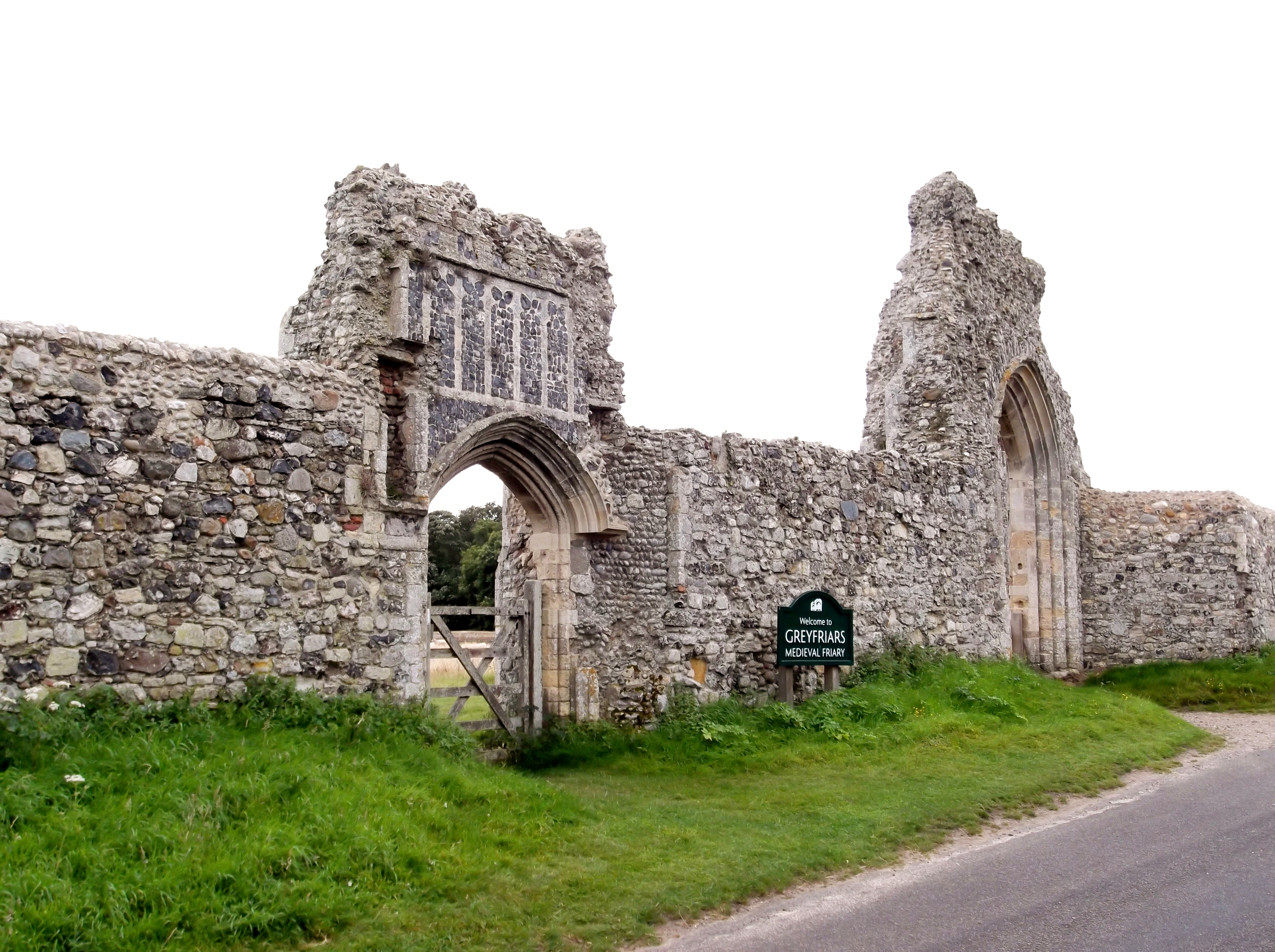
Minster Lovell Hall in Oxfordshire is one of those ruins that almost tricks you into behaving sensibly.
At first it looks like a gentle riverside stop: River Windrush, church next door, soft grass, broken gables, and that lovely old stone that makes people lower their voices even when nobody has asked them to. It is pretty in a very English way, which is probably why the story attached to it feels so much worse once you hear it.
Because this is not just a ruined with a nice walk beside it.
It is the place tied to Francis Lovell: Richard III’s loyal ally, a serious survivor, and a man who seems to have stepped out of history after the Battle of Stoke in 1487. No neat grave. No tidy death scene. No clean ending where everyone can file him away.
And because people hate a missing ending, a story grew up around the house.
a man vanishes / the walls get blamed
The vanished Yorkist

Francis Lovell was not a random man with a spooky local rumour attached to him. He was close to Richard III, fought on the losing side of the , and stayed dangerous after Henry VII took the throne because he represented something the new regime could not quite relax around: an old loyalty that had not fully died.
Some historical figures disappear because nobody cared enough to record them. Lovell is almost the opposite. He mattered, which makes the gap around him feel louder.
The last major Yorkist rising ended at the Battle of Stoke in 1487. The Yorkists lost. Lovell was reportedly seen escaping from the battlefield, and after that the trail thins into theories, hints and later stories. No satisfying final chapter. Just a man vanishing at the exact moment England was trying to decide whether the old world was over.
The skeleton in the story
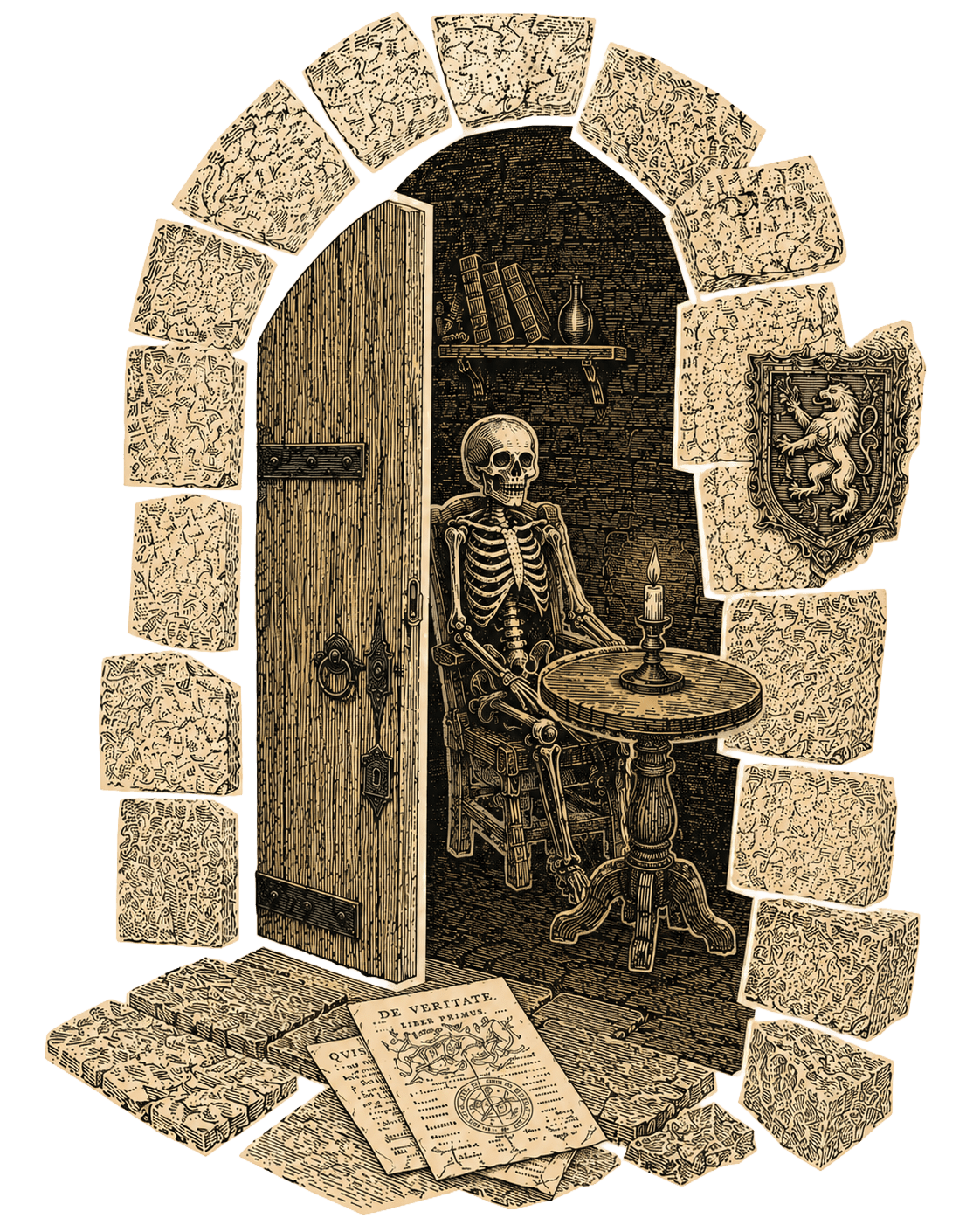
The legend says that much later, a sealed room or hidden chamber at Minster Lovell was opened, and inside was a skeleton. In some versions, the body is found seated at a table with papers, food or writing nearby. It is very easy to see why that version survived, because it is basically a complete Gothic scene in one image.
A loyal man escapes a lost cause.
He hides in a chamber.
The door is sealed, forgotten, or never opened again.
The house carries on above him.
I am saying legend very deliberately. This is not a solved case and it should not be dressed up as one. Nobody can stand in the ruins and say, with a straight face, “yes, that was definitely Francis Lovell.” The evidence does not give us that neat little gift.
But I also do not think the legend should be brushed off as silly local gossip. Ruins collect stories for a reason. When a place has missing rooms, missing roofs, missing records and a missing man attached to it, people start trying to make the absences speak to each other.
Why the rumour stuck
The story works because it is not completely random. Francis Lovell really did vanish from the record after 1487. Minster Lovell really was tied to his family. Old houses really do have hidden spaces, sealed rooms and later discoveries that can become attached to the nearest unresolved story.
That is the sweet spot for a ruin legend: not pure fantasy, not clean fact, but the annoying middle ground where your sensible brain says “probably not” and the atmosphere says “but imagine if…”
This is also where ruins do something museums cannot always do. A museum label tries to close the loop. A ruin gives you a frame with half the picture missing, and then your mind starts behaving badly.
Minster Lovell is very good at that. You are not looking at a full house. You are looking at the outline of a household, and outlines are dangerous because they make you fill things in.
A house built to show power

Minster Lovell Hall was built in the 1430s by William, Lord Lovell, on the site of an earlier manor. It was not built to feel spooky. That is just what time has done to it.
Originally, this was a house of status: a great hall, private rooms, service ranges, a courtyard, a tower, fishponds and a nearby. It would have been busy in the way wealthy houses are busy. Servants moving through service spaces, food arriving, visitors being received, family power being performed through architecture.
That is why the hidden-room legend lands so well. It is attached to a house built to organise who was visible, who served, who entered, who ate where, who had privacy, who mattered. A house built for display becomes, in the story, a house of concealment.
The more respectable the building once was, the darker the rumour becomes.
The dovecote is not just cute
The dovecote is easy to treat as a charming extra, but it explains the world of the house very quickly. It is a round, surviving reminder that privilege was not abstract. It had buildings. It had rights. It had birds.
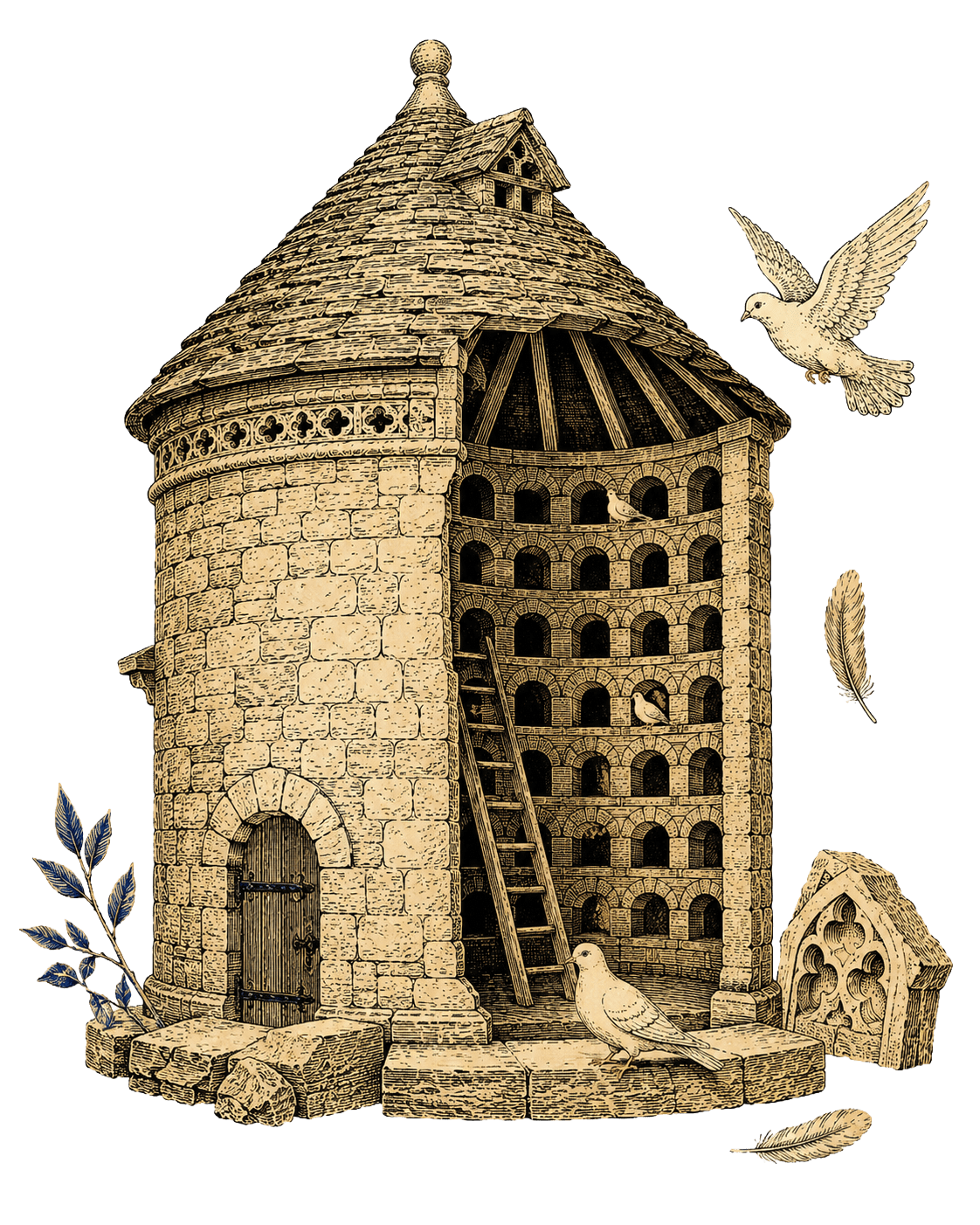
Rows of nesting holes might not sound dramatic until you remember what they meant. Doves and pigeons supplied meat, eggs and manure, but the right to keep them was also tied to land, rank and control. It is one of those details that looks sweet after the power has drained out of it.
The hall was not just honey-coloured stone by a river. It was a system of wealth. And if the legend is true — a very big if — then the man connected to all that status becomes the most hidden person in the house.
The missing ending is the relic
So did Francis Lovell die there? The honest answer is probably that we cannot know.
He may have escaped abroad. He may have died somewhere else. The skeleton story may have attached itself to him because people needed the disappearance to have a shape. That is less satisfying than a dramatic yes, but probably closer to the truth.
And still, the uncertainty does not ruin the story. It is the point.
The appeal of Minster Lovell is not that it proves Francis Lovell died behind a wall. It is that the place makes the question physically imaginable. Once you stand among the broken rooms and quiet stone, the legend stops being a sentence and becomes a way of looking.
A man vanishes from history.
A house becomes a ruin.
A chamber may or may not have held a body.
And centuries later, we are still trying to decide what kind of ending would make us feel better.
Enjoyed this one?
Get the next story straight to your inbox. No filler, no spam — just the next place worth writing about.
No spam. Unsubscribe any time.
Sources+
- English Heritage: History of Minster Lovell Hall and Dovecoteenglish-heritage.org.uk
- Wikipedia: Francis Lovell, 1st Viscount Lovellen.wikipedia.org
- Wikipedia: Battle of Stoke Fielden.wikipedia.org
- Image credits: Article images are credited to Wikimedia Commons where used and are under Creative Commons licences / public domain unless otherwise stated.
More articles
Swipe →