
Toothache is almost too ordinary to feel historical.
Everyone understands it. It is pain with no dignity. You can be trying to behave like a normal adult and then one tiny part of your mouth starts pulsing like it has developed a personal grudge against you. Suddenly you are bargaining with dentists, painkillers, your own jaw, God, whoever is available.
So I understand why people wanted an explanation before modern dentistry could give them one.
But the explanation they came up with was, frankly, horrible.
The tooth worm.
Not a real worm. A very real fear.
For a very long time, toothache was sometimes blamed on a tiny creature imagined as living inside the tooth, eating it, sucking from it, or gnawing at the root. It sounds ridiculous now, because we are used to talking about decay, infection, nerves and bacteria. But if you strip away what we know, the idea is not as random as it first seems.
Pain can feel alive. It moves. It pulses. It hides, then returns. It can feel as if something is working inside you with an agenda.
That is what makes the tooth worm such a good horrible idea.
A strange modern footnote, because it is too horrible not to mention: real oral parasites do exist, but they are not the same thing as the old tooth worm. Oral myiasis is a rare infestation of fly larvae in the mouth, usually linked to exposed tissue, wounds, tooth sockets, severe neglect, poor oral hygiene or vulnerable health. That is horrible in its own right, but it is not evidence that toothache is caused by a worm living inside healthy teeth. The folklore worm was an explanation for pain and decay. Oral myiasis is a separate medical condition that makes the old fear feel a little too close for comfort.
The pain had a character
One of the earliest written versions comes from ancient , in a text usually known as the Legend of the Worm. The worm is not just a vague pest in this story. It has appetite. It wants to be lifted up among the teeth and gums. It wants the blood of the tooth. It wants to gnaw the roots.
That is the part I find properly unsettling. The pain is not only being explained as a creature. It is being given a desire.
This is where ancient medicine becomes much more interesting than the lazy “people in the past were silly” version. The tooth worm was wrong, obviously. No one needs to defend it as science. But it was an attempt to make invisible pain visible. If something felt as if it was burrowing, biting or eating, then maybe the explanation would be a burrowing, biting, eating thing.
That is not stupidity. It is a body trying to make sense of itself with the tools it had.
The idea would not die neatly
The belief did not stay in one place. Versions of the tooth worm appear across different cultures and medical traditions, and the idea lasted for an impressively long time. It turns up in ancient and later sources, in learned medicine and popular remedies, in charms, treatments and the general human habit of trying absolutely anything when a tooth will not stop hurting.
And honestly, I get it.
Tooth pain is persuasive. It makes people vulnerable to explanations because the pain itself feels so specific. A headache can feel broad. A fever can feel like your whole body has gone wrong. But a toothache can feel like one exact point of attack. It has a location. It has a rhythm. It feels targeted.
So the tooth worm gave people a culprit. A little villain. Something to curse, charm, smoke out, kill or remove.
Toothache even got a saint
By the Christian Middle Ages, tooth pain had another kind of answer as well: Apollonia, the patron saint associated with toothache and dentistry. Her story involved the violent breaking or removal of her teeth, which is why she is often shown with pincers and a tooth.
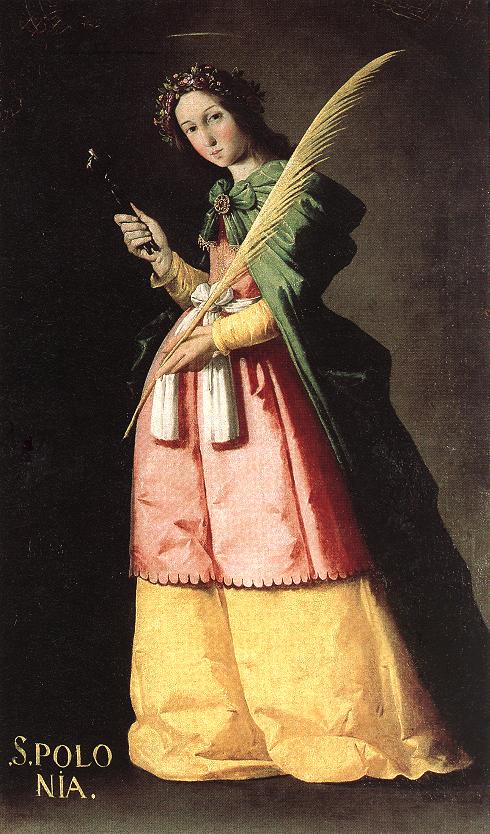
I like putting her next to the tooth worm idea because they are doing related but different jobs. The worm explains the pain. Apollonia gives the pain somewhere to go. One turns suffering into a creature. The other turns it into a prayer.
Neither is modern dentistry, obviously. But both show the same human problem: toothache is small enough to sound ridiculous until it is yours, and then suddenly it becomes the whole world.
Pain as a story
This is the bit I like most, because it is not only about dentistry. It is about how humans turn pain into narrative.
When something hurts and you do not know why, your mind starts building a story around it. Something is attacking me. Something is trapped in there. Something is spreading. Something is wrong in a way I cannot see. Modern medicine gives us better stories because they are based on anatomy, evidence and treatment, but they are still stories in the broad sense. They give pain a structure.
The tooth worm gave pain a character.
That is why the idea is so sticky. It turns a miserable physical sensation into a tiny dark drama: a creature inside the tooth, feeding at the root, making itself known through pain. It is disgusting, but it is also weirdly understandable.
The wrong lesson is “people in the past were stupid”. That is boring, and usually not very useful. People in the past were trying to live in bodies that hurt, failed, bled, swelled, rotted, healed and scared them, without the medical explanations we have now. They were not cartoon idiots. They were people with bad teeth and limited options, which is a combination that will make anyone open to strange ideas.
The better lesson is that wrong explanations can still tell us something real. The tooth worm tells us how pain felt. It tells us what kind of images people used when the inside of the body was hidden. It tells us that medicine, magic and metaphor were not always separate boxes.
And it tells us something very human: when pain has no visible cause, we start imagining one.
The thing under the ache
A surviving wrong explanation can work like a ruin. It is a fragment of an older world, and if you look at it closely, you can see the shape of the fears around it.
The tooth worm is gross enough to hook you, old enough to matter, and psychologically familiar enough to stop being just a joke. Because even now, when toothache starts up at 2am and you are lying there doing the pathetic little calculation of how many painkillers you can safely take before morning, it does not feel abstract.
It feels like something is in there.
Obviously, it is not a worm.
But I can see why people looked for one.
Enjoyed this one?
Get the next story straight to your inbox. No filler, no spam — just the next place worth writing about.
No spam. Unsubscribe any time.
Sources+
- Wikipedia: Tooth wormen.wikipedia.org
- Wikipedia: Toothache — History, society and cultureen.wikipedia.org
- Wikipedia: Saint Apolloniaen.wikipedia.org
- Gerabek, W. E. “The tooth-worm: historical aspects of a popular medical belief.” Clinical Oral Investigations 3 (1999): 1–6.
- Pritchard, James B., ed. Ancient Near Eastern Texts Relating to the Old Testament. Princeton University Press, 1955.
- Wikipedia: Myiasisen.wikipedia.org
- Times of India: Mouth larvae / oral myiasis overviewtimesofindia.indiatimes.com
- Image credits: Article images are credited to Wikimedia Commons where used and are under Creative Commons licences / public domain unless otherwise stated.
More articles
Swipe →

